
การปรับเปลี่ยนความคิดและพฤติกรรมแบบความเข้มข้นต่ำ (LiCBT) สำหรับการสร้างเสริมสุขภาพในกลุ่มนักศึกษามหาวิทยาลัย ในประเทศไทย: การศึกษาประสิทธิผลของการนำผลวิจัยไปสู่การปฏิบัติ
| dc.contributor.author | ดรุณี ภู่ขาว | th_TH |
| dc.contributor.author | Darunee Phukao | th_TH |
| dc.contributor.author | ไชยันต์ สกุลศรีประเสริฐ | th_TH |
| dc.contributor.author | Chaiyun Sakulsriprasert | th_TH |
| dc.contributor.author | รติพันธ์ ถาวรวุฒิชาติ | th_TH |
| dc.contributor.author | Ratipan Thawornwutichat | th_TH |
| dc.contributor.author | สรินฎา ปุติ | th_TH |
| dc.contributor.author | Sarinda Puti | th_TH |
| dc.contributor.author | ปิยนุช ยอดสมสวย | th_TH |
| dc.contributor.author | Piyanuch Yoadsomsuay | th_TH |
| dc.contributor.author | สุจิรา วิชัยดิษฐ | th_TH |
| dc.contributor.author | Sujira Wichaidit | th_TH |
| dc.date.accessioned | 2026-07-20T02:41:42Z | |
| dc.date.available | 2026-07-20T02:41:42Z | |
| dc.date.issued | 2569-07 | |
| dc.identifier.other | hs3402 | |
| dc.identifier.uri | http://hdl.handle.net/11228/6457 | |
| dc.description.abstract | การสร้างเสริมสุขภาพจิตในนักศึกษามหาวิทยาลัยเป็นประเด็นสำคัญของระบบสุขภาพไทย เนื่องจากนักศึกษาเป็นกลุ่มที่มีความเสี่ยงต่อปัญหาสุขภาพจิต ขณะที่การเข้าถึงบริการสุขภาพจิตยังมีข้อจำกัดด้านทรัพยากรและบุคลากร การปรับเปลี่ยนความคิดและพฤติกรรมแบบความเข้มข้นต่ำ (Low-Intensity Cognitive Behavioral Therapy: LiCBT) เป็นแนวทางที่มีศักยภาพในการส่งเสริมสุขภาพจิตในระดับประชากร งานวิจัยนี้มีวัตถุประสงค์เพื่อศึกษาประสิทธิผลและกระบวนการนำ LiCBT ไปใช้ในระบบการสร้างเสริมสุขภาพนักศึกษามหาวิทยาลัยของประเทศไทย การวิจัยใช้รูปแบบการศึกษาวิจัยเชิงประสิทธิผลควบคู่การนำไปปฏิบัติ (Effectiveness-Implementation Hybrid Study) โดยดำเนินงานร่วมกับมหาวิทยาลัยเครือข่าย ผ่านการพัฒนาทีมขับเคลื่อนการเปลี่ยนแปลง (Change Agent) การฝึกอบรมผู้ช่วยการปรับเปลี่ยนความคิดและพฤติกรรมแบบความเข้มข้นต่ำ (LiCBT Helper) และการดำเนินโปรแกรม LiCBT สำหรับนักศึกษาในรูปแบบชั้นเรียนแบบผสมผสาน (Hybrid Classroom-Based LiCBT Program) เก็บรวบรวมข้อมูลทั้งเชิงปริมาณและเชิงคุณภาพเพื่อประเมินผลลัพธ์ด้านประสิทธิผลและผลลัพธ์ด้านการนำไปใช้ ผลการวิจัยพบว่า โปรแกรม LiCBT สามารถนำไปใช้ในบริบทมหาวิทยาลัยไทยได้จริง ได้รับการยอมรับจากผู้บริหาร อาจารย์ ผู้ดำเนินโปรแกรม และนักศึกษา มีความเป็นไปได้ในการดำเนินงานภายใต้ทรัพยากรที่มีอยู่ และสามารถบูรณาการเข้าสู่ระบบกิจกรรมนักศึกษาและระบบการสร้างเสริมสุขภาพของมหาวิทยาลัยได้ ผลลัพธ์ด้านประสิทธิผลแสดงให้เห็นแนวโน้มการพัฒนาสุขภาวะทางจิต ทักษะการจัดการอารมณ์ และทักษะการปรับเปลี่ยนความคิดของนักศึกษา ขณะที่ผลลัพธ์ด้านการนำไปใช้สะท้อนให้เห็นถึงปัจจัยสำคัญที่เอื้อต่อความสำเร็จ ได้แก่ การสนับสนุนจากผู้บริหาร การมีทีมขับเคลื่อนภายในมหาวิทยาลัย การพัฒนาศักยภาพบุคลากร และการออกแบบโปรแกรมที่สอดคล้องกับบริบทของนักศึกษา องค์ความรู้ที่ได้จากการศึกษานำไปสู่การพัฒนาต้นแบบการสร้างเสริมสุขภาพจิตนักศึกษาในมหาวิทยาลัย (University Mental Health Promotion Model) รูปแบบการพัฒนาทีม Change Agent และ LiCBT Helper ตลอดจนแนวทางบริการสุขภาพจิตแบบความเข้มข้นต่ำที่สามารถขยายผลได้ในบริบทของสถาบันอุดมศึกษาไทย ผลการศึกษามีความสำคัญต่อการพัฒนานโยบายและระบบบริการสุขภาพจิตนักศึกษาและสนับสนุนการพัฒนาระบบสุขภาพจิตเชิงป้องกันของประเทศในระยะยาว | th_TH |
| dc.description.sponsorship | สถาบันวิจัยระบบสาธารณสุข | th_TH |
| dc.language.iso | th | th_TH |
| dc.publisher | สถาบันวิจัยระบบสาธารณสุข | th_TH |
| dc.rights | สถาบันวิจัยระบบสาธารณสุข | th_TH |
| dc.subject | การสร้างเสริมสุขภาพ | th_TH |
| dc.subject | Health Promotion | th_TH |
| dc.subject | สุขภาพจิต | th_TH |
| dc.subject | Mental Health | th_TH |
| dc.subject | การส่งเสริมสุขภาพจิต | th_TH |
| dc.subject | ภาวะผู้นำและการอภิบาล (Leadership and Governance) | th_TH |
| dc.title | การปรับเปลี่ยนความคิดและพฤติกรรมแบบความเข้มข้นต่ำ (LiCBT) สำหรับการสร้างเสริมสุขภาพในกลุ่มนักศึกษามหาวิทยาลัย ในประเทศไทย: การศึกษาประสิทธิผลของการนำผลวิจัยไปสู่การปฏิบัติ | th_TH |
| dc.title.alternative | Low Intensity Cognitive Behavioral Therapy (LiCBT) for Promoting University Students’ Health in Thailand: Effectiveness-implementation Hybrid Study | th_TH |
| dc.type | Technical Report | th_TH |
| dc.description.abstractalternative | Mental health promotion among university students has become an important public health priority in Thailand. University students are at increased risk of mental health problems, while access to psychological services remains limited due to resource and workforce constraints. Low-Intensity Cognitive Behavioral Therapy (LiCBT) has been recognized as a promising population-based approach for promoting mental well-being and increasing access to mental health support. This study aimed to examine both the effectiveness and implementation of LiCBT within the university mental health promotion system in Thailand. An Effectiveness-Implementation Hybrid Study design was employed. The project was conducted in collaboration with participating universities through the development of Change Agents, training of LiCBT Helpers, and delivery of a Hybrid Classroom-Based LiCBT Program for university students. Quantitative and qualitative data were collected to evaluate both effectiveness outcomes and implementation outcomes. The findings demonstrated that LiCBT could be successfully implemented within Thai university settings. The program was acceptable to university administrators, facilitators, and students, feasible under existing resource constraints, and capable of being integrated into student development and health promotion systems. Effectiveness outcomes indicated improvements in psychological wellbeing, emotional management skills, and cognitive coping skills among participating students. Implementation findings highlighted key facilitators of successful implementation, including leadership support, internal implementation teams, workforce development, and contextual adaptation of the intervention. The study generated practical knowledge for the development of a University Mental Health Promotion Model, a Change Agent and LiCBT Helper Development Model, and a Low-Intensity Mental Health Care Model suitable for higher education settings in Thailand. The findings provide important implications for university mental health policy, service development, and the advancement of preventive mental health systems at the national level. | th_TH |
| dc.identifier.contactno | 68-037 | |
| dc.subject.keyword | LiCBT | th_TH |
| dc.subject.keyword | Low-Intensity Cognitive Behavioral Therapy | th_TH |
| .custom.citation | ดรุณี ภู่ขาว, Darunee Phukao, ไชยันต์ สกุลศรีประเสริฐ, Chaiyun Sakulsriprasert, รติพันธ์ ถาวรวุฒิชาติ, Ratipan Thawornwutichat, สรินฎา ปุติ, Sarinda Puti, ปิยนุช ยอดสมสวย, Piyanuch Yoadsomsuay, สุจิรา วิชัยดิษฐ and Sujira Wichaidit. "การปรับเปลี่ยนความคิดและพฤติกรรมแบบความเข้มข้นต่ำ (LiCBT) สำหรับการสร้างเสริมสุขภาพในกลุ่มนักศึกษามหาวิทยาลัย ในประเทศไทย: การศึกษาประสิทธิผลของการนำผลวิจัยไปสู่การปฏิบัติ." 2569. <a href="http://hdl.handle.net/11228/6457">http://hdl.handle.net/11228/6457</a>. | |
| .custom.total_download | 1 | |
| .custom.downloaded_today | 0 | |
| .custom.downloaded_this_month | 1 | |
| .custom.downloaded_this_year | 1 | |
| .custom.downloaded_fiscal_year | 1 |
 | ผลงานวิชาการเหล่านี้เป็นลิขสิทธิ์ของสถาบันวิจัยระบบสาธารณสุข หากมีการนำไปใช้อ้างอิง โปรดอ้างถึงสถาบันวิจัยระบบสาธารณสุข ในฐานะเจ้าของลิขสิทธิ์ตามพระราชบัญญัติสงวนลิขสิทธิ์สำหรับการนำงานวิจัยไปใช้ประโยชน์ในเชิงพาณิชย์ |
ฉบับเต็ม
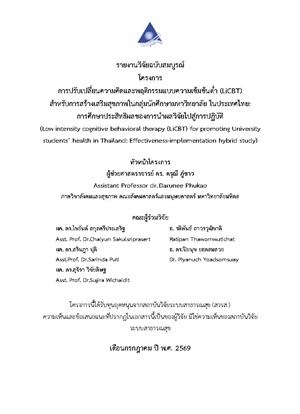
ชื่อ: hs3402.pdf
ขนาด: 2.259Mb
รูปแบบ: PDF
ชิ้นงานนี้ปรากฎในคอลเล็คชั่นต่อไปนี้
-
Research Reports [2595]
งานวิจัย