
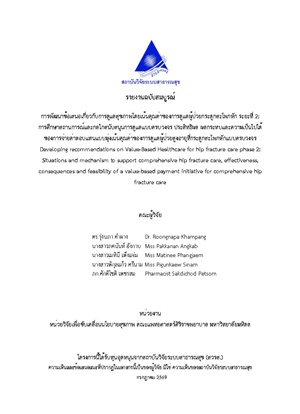
Developing Recommendations on Value-Based Healthcare for Hip Fracture Care Phase 2: Situations and Mechanism to Support Comprehensive Hip Fracture Care, Effectiveness, Consequences and Feasibility of a Value-based Payment Initiative for Comprehensive Hip Fracture Care
| dc.contributor.author | รุ่งนภา คำผาง | th_TH |
| dc.contributor.author | Roongnapa Khampang | th_TH |
| dc.contributor.author | ภคนันท์ อังกาบ | th_TH |
| dc.contributor.author | Pakkanan Angkab | th_TH |
| dc.contributor.author | เมทินี เพ็งแจ่ม | th_TH |
| dc.contributor.author | Matinee Phangjaem | th_TH |
| dc.contributor.author | พิกุลแก้ว ศรีนาม | th_TH |
| dc.contributor.author | Pigunkaew Sinam | th_TH |
| dc.contributor.author | ศักดิโชติ เพชรสม | th_TH |
| dc.contributor.author | Sakdichod Petsom | th_TH |
| dc.date.accessioned | 2026-07-13T09:08:09Z | |
| dc.date.available | 2026-07-13T09:08:09Z | |
| dc.date.issued | 2569-07 | |
| dc.identifier.other | hs3406 | |
| dc.identifier.uri | http://hdl.handle.net/11228/6456 | |
| dc.description.abstract | ภาวะกระดูกสะโพกหักในผู้สูงอายุเป็นปัญหาสาธารณสุขสำคัญที่มีแนวโน้มเพิ่มขึ้นอย่างต่อเนื่องในประเทศไทย และสัมพันธ์กับอัตราการเสียชีวิต การสูญเสียความสามารถในการดำเนินชีวิต และภาระต่อครอบครัวและระบบสุขภาพ แม้ว่าจะมีนโยบายส่งเสริมการผ่าตัดอย่างรวดเร็วและการดูแลแบบสหสาขาวิชาชีพ แต่ยังพบข้อจํากัดด้านการเข้าถึงบริการ ความครอบคลุมของการผ่าตัด และความต่อเนื่องของการดูแล รวมถึงกลไกการจ่ายค่าตอบแทนที่ยังไม่เชื่อมโยงกับผลลัพธ์สุขภาพอย่างชัดเจน การศึกษานี้มีวัตถุประสงค์เพื่อพัฒนาข้อเสนอเชิงนโยบายเกี่ยวกับการดูแลผู้ป่วยกระดูกสะโพกหักแบบมุ่งเน้นคุณค่าและกลไกการจ่ายค่าตอบแทนที่เหมาะสม การศึกษานี้ใช้วิธีวิจัยแบบผสมผสาน โดยการศึกษาเชิงคุณภาพประกอบด้วยการอภิปรายกลุ่มและการสัมภาษณ์เชิงลึกจากผู้ให้บริการทางการแพทย์ 34 คน และผู้ป่วย ญาติ หรือผู้ดูแล 31 คน จากสถานพยาบาลใน 4 ภูมิภาค คัดเลือกด้วยวิธี purposive และ snowball sampling นอกจากนี้ มีการอภิปรายกลุ่มผู้ให้บริการในเขตสุขภาพที่ 1 ที่มีประสบการณ์การเบิกจ่ายค่าตอบแทนเพิ่มเติม การศึกษาเชิงปริมาณประกอบด้วยการสํารวจสถานพยาบาลเกี่ยวกับการให้บริการแบบครบวงจร และการวิเคราะห์ข้อมูลการเข้ารับบริการผู้ป่วยกระดูกสะโพกหักจากฐานข้อมูลระดับประเทศ ระหว่างปี พ.ศ. 2563–2567 ผลการศึกษาพบว่า อัตราการผ่าตัดในประเทศไทยยังอยู่ในระดับจํากัด (ร้อยละ 70) โดยผู้ป่วยที่ได้รับการผ่าตัดมีอัตราการเสียชีวิตภายใน 3 เดือนตํ่ากว่าผู้ที่ไม่ได้รับการผ่าตัดถึง 3.7 เท่า ปัจจัยสำคัญที่เป็นอุปสรรค ได้แก่ ความไม่ชัดเจนของนโยบายระดับประเทศ การสื่อสารและการกำกับติดตามที่ไม่ต่อเนื่อง การตัดสินใจของผู้ป่วยและญาติที่มีความกังวลต่อความเสี่ยงของการผ่าตัด ระบบส่งต่อที่ยังไม่มีประสิทธิภาพ และข้อจํากัดของการดูแลต่อเนื่องหลังออกจากโรงพยาบาล นอกจากนี้ โครงสร้างค่าตอบแทนในปัจจุบันยังไม่สะท้อนต้นทุนที่แท้จริง ส่งผลต่อศักยภาพของสถานพยาบาลในการให้บริการ ขณะที่มาตรการจูงใจทางการเงินมีความสัมพันธ์กับการลดการเสียชีวิตระยะสั้น แต่ยังไม่ส่งผลต่อผลลัพธ์ระยะยาวอย่างมีนัยสําคัญ ข้อเสนอเชิงนโยบายเน้นการกำหนดตัวชี้วัดและการสื่อสารนโยบายระดับประเทศที่ชัดเจน การพัฒนาระบบส่งต่อและการดูแลแบบครบวงจร การเสริมสร้างการมีส่วนร่วมของผู้ป่วยและชุมชน และการพัฒนากลไกการจ่ายค่าตอบแทนแบบมุ่งเน้นคุณค่าที่เชื่อมโยงกับผลลัพธ์สุขภาพในทุกระยะของการดูแล เพื่อยกระดับคุณภาพบริการและผลลัพธ์สุขภาพของผู้ป่วยอย่างยั่งยืน | th_TH |
| dc.description.sponsorship | สถาบันวิจัยระบบสาธารณสุข | th_TH |
| dc.language.iso | th | th_TH |
| dc.publisher | สถาบันวิจัยระบบสาธารณสุข | th_TH |
| dc.rights | สถาบันวิจัยระบบสาธารณสุข | th_TH |
| dc.subject | Hip Joint--Fractures | th_TH |
| dc.subject | กระดูกหัก | th_TH |
| dc.subject | Hip Fractures--in Old Age | th_TH |
| dc.subject | ผู้สูงอายุ | th_TH |
| dc.subject | ภาวะผู้นำและการอภิบาล (Leadership and Governance) | th_TH |
| dc.subject | นโยบายสาธารณสุข | th_TH |
| dc.subject | Health Policy | th_TH |
| dc.subject | นโยบายสุขภาพ | th_TH |
| dc.title | การพัฒนาข้อเสนอเกี่ยวกับการดูแลสุขภาพโดยเน้นคุณค่าของการดูแลผู้ป่วยกระดูกสะโพกหัก ระยะที่ 2: การศึกษาสถานการณ์และกลไกสนับสนุนการดูแลแบบครบวงจร ประสิทธิผล ผลกระทบและความเป็นไปได้ของการจ่ายค่าตอบแทนแบบมุ่งเน้นคุณค่าของการดูแลผู้ป่วยสูงอายุที่กระดูกสะโพกหักแบบครบวงจร | th_TH |
| dc.title.alternative | Developing Recommendations on Value-Based Healthcare for Hip Fracture Care Phase 2: Situations and Mechanism to Support Comprehensive Hip Fracture Care, Effectiveness, Consequences and Feasibility of a Value-based Payment Initiative for Comprehensive Hip Fracture Care | th_TH |
| dc.type | Technical Report | th_TH |
| dc.description.abstractalternative | Background: Hip fracture among older adults is a growing public health challenge in Thailand, associated with high mortality, loss of functional independence, and substantial health system burden. Despite national efforts to promote early surgery and multidisciplinary care, gaps remain in access, continuity of care, and alignment of provider payment with health outcomes. This study aimed to generate policy recommendations for value-based hip fracture care and appropriate provider payment mechanisms. Methods: A mixed-methods study was conducted. The qualitative component included focus group discussions and in-depth interviews with healthcare providers (n=34) and patients, caregivers, or relatives (n=31) from hospitals across four regions, selected using purposive and snowball sampling. Additional focus groups were conducted with providers experienced in financial incentive schemes in Health Region 1. The quantitative component comprised (1) a structured survey of hospitals assessing comprehensive care capacity, and (2) analysis of national administrative data on hip fracture service utilization from 12 health regions between 2020 and 2024. Results: The national hip fracture surgery rate remained suboptimal (approximately 70%). Patients undergoing surgery had a 3.7-fold lower 3-month mortality compared with those not receiving surgery. Key barriers included unclear national policy direction, inconsistent communication and monitoring, patient and family concerns regarding surgical risks and long-term care burden, inefficient referral systems, and limited access to post-acute and continuous care. Current payment structures were misaligned with actual costs, constraining hospitals' capacity for surgical and multidisciplinary services. Financial incentives at the hospital level were associated with reduced short-term mortality but showed limited impact on longer-term outcomes, such as readmissions or recurrent fractures. The absence of integrated performance indicators, linked data systems, and outcome-based payment mechanisms hindered the transition toward value-based care. Conclusions: Strengthening hip fracture care in Thailand requires clearer national policy signals, improved referral and integrated care pathways, and enhanced patient engagement. A value-based payment model linked to outcomes across the continuum of care, spanning primary prevention, acute care, and rehabilitation, is essential to improve both short- and long-term outcomes. Complementary system reforms, including standardized clinical pathways, data integration, and community-based support, are critical to ensure sustainable and equitable service delivery. | th_TH |
| dc.identifier.contactno | 68-041 | |
| dc.subject.keyword | Value-Based Healthcare | th_TH |
| dc.subject.keyword | VBHC | th_TH |
| .custom.citation | รุ่งนภา คำผาง, Roongnapa Khampang, ภคนันท์ อังกาบ, Pakkanan Angkab, เมทินี เพ็งแจ่ม, Matinee Phangjaem, พิกุลแก้ว ศรีนาม, Pigunkaew Sinam, ศักดิโชติ เพชรสม and Sakdichod Petsom. "การพัฒนาข้อเสนอเกี่ยวกับการดูแลสุขภาพโดยเน้นคุณค่าของการดูแลผู้ป่วยกระดูกสะโพกหัก ระยะที่ 2: การศึกษาสถานการณ์และกลไกสนับสนุนการดูแลแบบครบวงจร ประสิทธิผล ผลกระทบและความเป็นไปได้ของการจ่ายค่าตอบแทนแบบมุ่งเน้นคุณค่าของการดูแลผู้ป่วยสูงอายุที่กระดูกสะโพกหักแบบครบวงจร." 2569. <a href="http://hdl.handle.net/11228/6456">http://hdl.handle.net/11228/6456</a>. | |
| .custom.total_download | 1 | |
| .custom.downloaded_today | 1 | |
| .custom.downloaded_this_month | 1 | |
| .custom.downloaded_this_year | 1 | |
| .custom.downloaded_fiscal_year | 1 |
 | ผลงานวิชาการเหล่านี้เป็นลิขสิทธิ์ของสถาบันวิจัยระบบสาธารณสุข หากมีการนำไปใช้อ้างอิง โปรดอ้างถึงสถาบันวิจัยระบบสาธารณสุข ในฐานะเจ้าของลิขสิทธิ์ตามพระราชบัญญัติสงวนลิขสิทธิ์สำหรับการนำงานวิจัยไปใช้ประโยชน์ในเชิงพาณิชย์ |
Fulltext
Name: hs3406.pdf
Size: 11.05Mb
Format: PDF
This item appears in the following Collection(s)
-
Research Reports [2591]
งานวิจัย