
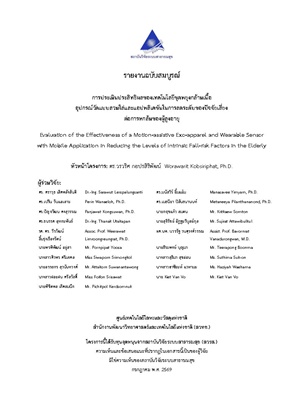
การประเมินประสิทธิผลของเทคโนโลยีชุดพยุงกล้ามเนื้อ อุปกรณ์วัดแบบสวมใส่และแอปพลิเคชันในการลดระดับของปัจจัยเสี่ยงต่อการหกล้มของผู้สูงอายุ
| dc.contributor.author | วรวริศ กอปรสิริพัฒน์ | th_TH |
| dc.contributor.author | Worawarit Kobsiriphat | th_TH |
| dc.contributor.author | ศราวุธ เลิศพลังสันติ | th_TH |
| dc.contributor.author | Sarawut Lerspalungsanti | th_TH |
| dc.contributor.author | มนัสวีร์ ยิ้มแย้ม | th_TH |
| dc.contributor.author | Manasavee Yimyam | th_TH |
| dc.contributor.author | เปริน วันแอเลาะ | th_TH |
| dc.contributor.author | Perin Wanaeloh | th_TH |
| dc.contributor.author | เมธนียา ปิลันธนานนท์ | th_TH |
| dc.contributor.author | Metaneeya Pilanthananond | th_TH |
| dc.contributor.author | ปัญจวัฒน คงสุวรรณ | th_TH |
| dc.contributor.author | Panjawat Kongsuwan | th_TH |
| dc.contributor.author | กฤชแก้ว สมตน | th_TH |
| dc.contributor.author | Kritkaew Somton | th_TH |
| dc.contributor.author | ธนรรค อุทกะพันธ์ | th_TH |
| dc.contributor.author | Thanak Utakapan | th_TH |
| dc.contributor.author | สุจิรัชย์ อัฏฐะวิบูลย์กุล | th_TH |
| dc.contributor.author | Sujirat Attawibulkul | th_TH |
| dc.contributor.author | วีรวัฒน์ ลิ้มรุ่งเรืองรัตน์ | th_TH |
| dc.contributor.author | Weerawat Limroongreungrat | th_TH |
| dc.contributor.author | บวรรัฐ วนดุรงค์วรรณ | th_TH |
| dc.contributor.author | Bavornrat Vanadurongwan | th_TH |
| dc.contributor.author | พรพิพัฒน์ อยู่สา | th_TH |
| dc.contributor.author | Pornpipat Yoosa | th_TH |
| dc.contributor.author | ธีระพงษ์ บุญมา | th_TH |
| dc.contributor.author | Teerapong Boonma | th_TH |
| dc.contributor.author | ศิวพร ศรีมงคล | th_TH |
| dc.contributor.author | Siwaporn Srimongkol | th_TH |
| dc.contributor.author | สุธิมา สุขอ่อน | th_TH |
| dc.contributor.author | Suthima Suk-on | th_TH |
| dc.contributor.author | อรรถกร สุวนันทวงศ์ | th_TH |
| dc.contributor.author | Attakorn Suwanantawong | th_TH |
| dc.contributor.author | ฮาซียะห์ แวหามะ | th_TH |
| dc.contributor.author | Haziyah Waehama | th_TH |
| dc.contributor.author | ฝอยฝน ศรีสวัสดิ์ | th_TH |
| dc.contributor.author | Foifon Srisawat | th_TH |
| dc.contributor.author | Vo, Kiet Van | th_TH |
| dc.contributor.author | พิชิตพล เกิดสมนึก | th_TH |
| dc.contributor.author | Pichitpol Kerdsomnuk | th_TH |
| dc.date.accessioned | 2026-07-20T06:47:11Z | |
| dc.date.available | 2026-07-20T06:47:11Z | |
| dc.date.issued | 2569-07 | |
| dc.identifier.other | hs3404 | |
| dc.identifier.uri | http://hdl.handle.net/11228/6458 | |
| dc.description.abstract | การประเมินประสิทธิผลของชุดพยุงกล้ามเนื้อ และอุปกรณ์วัดแบบสวมใส่และแอปพลิเคชัน ในการลดระดับของปัจจัยเสี่ยงต่อการหกล้มในผู้สูงอายุ กำหนดกรอบการศึกษาครอบคลุม 4 โครงการย่อย ได้แก่ (1) การประเมินประสิทธิผลเชิงชีวกลศาสตร์ของชุดพยุงกล้ามเนื้อแบบภาคตัดขวาง (2) การประเมินผลระยะยาวของชุดพยุงกล้ามเนื้อ (3) การประเมินผลระยะยาวของอุปกรณ์วัดแบบสวมใส่และแอปพลิเคชันต่อพฤติกรรมการทรงท่า และ (4) การประเมินความเที่ยงตรงและความเชื่อมั่นของระบบตรวจวัด เพื่อสร้างหลักฐานเชิงประจักษ์ทั้งในด้านผลลัพธ์เชิงหน้าที่ เชิงคลินิก เชิงพฤติกรรม และคุณสมบัติของระบบวัด ผลการศึกษาชี้ว่าชุดพยุงกล้ามเนื้อมีศักยภาพในการลดปัจจัยเสี่ยงต่อการหกล้มในผู้สูงอายุ โดยให้ผลในทิศทางที่เป็นประโยชน์ต่อการทรงตัว การลุกยืนจากท่านั่ง และการควบคุมการเคลื่อนไหว ในการศึกษาภาคตัดขวาง (โครงการย่อยที่ 1) พบผลเชิงบวกเด่นในตัวชี้วัดที่สะท้อนการควบคุมสมดุลในแนวด้านข้างและประสิทธิภาพการถ่ายน้ำหนัก ขณะที่การศึกษาติดตามระยะยาว (โครงการย่อยที่ 2) พบแนวโน้มการทรงตัวดีขึ้นภายหลังการใช้งานต่อเนื่อง 3 เดือน โดยเฉพาะในการทดสอบยืนต่อเท้าครึ่งหนึ่ง และมีข้อบ่งชี้ของ carry-over effect แม้ในสภาวะไม่สวมใส่ชุดขณะประเมิน ซึ่งสนับสนุนความเป็นไปได้ของการปรับตัวของระบบประสาทสั่งการจากการใช้งานต่อเนื่องในชีวิตประจำวันสำหรับอุปกรณ์วัดแบบสวมใส่และแอปพลิเคชัน ผลการศึกษาในโครงการย่อยที่ 3 สนับสนุนว่าระบบมีศักยภาพทั้งในฐานะเครื่องมือตรวจวัดและเครื่องมือสนับสนุนการปรับพฤติกรรมการทรงท่า โดยการใช้งานต่อเนื่อง 90 วันสัมพันธ์กับการเปลี่ยนแปลงอย่างมีนัยสำคัญของตัวชี้วัดทางคลินิกบางตัว โดยเฉพาะ forward shoulder angle ซึ่งสะท้อนการปรับพฤติกรรมการทรงท่าในระยะยาว ขณะเดียวกัน การศึกษาความเที่ยงตรงและความเชื่อมั่นยืนยันว่าระบบมีสมรรถนะสูง โดยเฉพาะการวัดมุมการก้มตัวผ่านแกน Pitch ที่ตำแหน่ง T3 ซึ่งเป็นตำแหน่งที่เหมาะสมที่สุดสำหรับการใช้งานขณะเคลื่อนไหว ในภาพรวมโครงการนี้ได้สร้างองค์ความรู้ที่เชื่อมโยงจากระดับกลไกของเทคโนโลยีไปสู่ผลต่อปัจจัยเสี่ยงต่อการหกล้มในผู้สูงอายุอย่างเป็นระบบ โดยชุดพยุงกล้ามเนื้อมีศักยภาพในฐานะเทคโนโลยีช่วยเสริมการเคลื่อนไหวและความมั่นคงของร่างกาย ส่วนอุปกรณ์วัดแบบสวมใส่และแอปพลิเคชัน มีศักยภาพในฐานะเครื่องมือประเมินท่าทางและสนับสนุนการปรับพฤติกรรม อย่างไรก็ดี การต่อยอดสู่การใช้ประโยชน์จริงควรสอดคล้องกับกลุ่มเป้าหมายและบริบทการใช้งาน โดยในส่วนของชุดพยุงกล้ามเนื้อ ควรเร่งสร้างหลักฐานวิชาการเพื่อรองรับการผลักดันเข้าสู่บัญชีนวัตกรรมไทย และการพิจารณาในระบบหลักประกันสุขภาพแห่งชาติ ขณะที่อุปกรณ์วัดแบบสวมใส่และแอปพลิเคชันควรพัฒนาแนวทางใช้ประโยชน์ให้เหมาะสมทั้งในกลุ่มวัยทำงานและในบริบทการประเมินโดยบุคลากรสุขภาพสำหรับผู้สูงอายุ | th_TH |
| dc.description.sponsorship | สถาบันวิจัยระบบสาธารณสุข | th_TH |
| dc.language.iso | th | th_TH |
| dc.publisher | สถาบันวิจัยระบบสาธารณสุข | th_TH |
| dc.rights | สถาบันวิจัยระบบสาธารณสุข | th_TH |
| dc.subject | Elderly | th_TH |
| dc.subject | Aging | th_TH |
| dc.subject | Older People | th_TH |
| dc.subject | ผู้สูงอายุ | th_TH |
| dc.subject | ผู้สูงอายุ--การเคลื่อนไหว | th_TH |
| dc.subject | ผู้สูงอายุ--สุขภาพและอนามัย | th_TH |
| dc.subject | ผู้สูงอายุ--อุปกรณ์และเครื่องมือแพทย์ | th_TH |
| dc.subject | โปรแกรมประยุกต์ | th_TH |
| dc.subject | Application Software | th_TH |
| dc.subject | Mobile Applications | th_TH |
| dc.subject | โทรศัพท์เคลื่อนที่--โปรแกรมประยุกต์ | th_TH |
| dc.subject | นวัตกรรมทางการแพทย์ | th_TH |
| dc.subject | ผลิตภัณฑ์ วัคซีน และเทคโนโลยีทางการแพทย์ (Medical Products, Vaccines and Technologies) | th_TH |
| dc.title | การประเมินประสิทธิผลของเทคโนโลยีชุดพยุงกล้ามเนื้อ อุปกรณ์วัดแบบสวมใส่และแอปพลิเคชันในการลดระดับของปัจจัยเสี่ยงต่อการหกล้มของผู้สูงอายุ | th_TH |
| dc.title.alternative | Evaluation of the Effectiveness of a Motion-assistive Exo-apparel and Wearable Sensor with Mobile Application in Reducing the Levels of Intrinsic Fall-risk Factors in the Elderly | th_TH |
| dc.type | Technical Report | th_TH |
| dc.description.abstractalternative | The research team conducted this project to evaluate the effectiveness of the exoapparel and wearable sensor with mobile application in reducing fall-risk-related factors in older adults. The study comprised four interrelated subprojects: (1) cross-sectional biomechanical evaluation of the exo-apparel, (2) longitudinal evaluation of the exo-apparel, (3) longitudinal evaluation of the wearable sensor and application for postural behavior modification, and (4) a validity and reliability study of the measurement system, generating evidence across functional, clinical, behavioral, and measurement domains. The findings indicate that the exo-apparel has potential to reduce fall-risk-related factors in older adults. The cross-sectional study showed beneficial effects on balance and sit-to-stand performance, particularly in mediolateral stability and weight transfer efficiency, while the longitudinal study found that three months of continuous use was associated with improved standing balance, especially under semi-tandem conditions. Improvements observed even under non-wear assessment conditions suggest a possible carry-over effect related to neuromuscular adaptation. The wearable sensor and mobile application also demonstrated promise as both a monitoring and posture-related behavioral support system. Ninety days of use was associated with significant improvement in selected clinical posture outcomes, particularly forward shoulder angle. In parallel, the validity and reliability study confirmed high measurement performance, especially for trunk flexion detection through the pitch axis at the T3 position, supporting its use as a posture assessment instrument in research settings. Overall, the project provides integrated evidence linking technology mechanisms to fallrisk-related outcomes in older adults. The exo-apparel shows promise for movement assistance and postural stability, whereas the wearable sensor and mobile application show promise for posture measurement and behavioral support. Future translation should focus on strengthening publication-based evidence for health technology adoption, advancing the exo-apparel toward the Thai Innovation List and potential national reimbursement pathways, and refining the positioning of the wearable system for appropriate target users and real-world implementation contexts. | th_TH |
| dc.identifier.contactno | 68-006 | |
| dc.subject.keyword | ชุดพยุงกล้ามเนื้อ | th_TH |
| .custom.citation | วรวริศ กอปรสิริพัฒน์, Worawarit Kobsiriphat, ศราวุธ เลิศพลังสันติ, Sarawut Lerspalungsanti, มนัสวีร์ ยิ้มแย้ม, Manasavee Yimyam, เปริน วันแอเลาะ, Perin Wanaeloh, เมธนียา ปิลันธนานนท์, Metaneeya Pilanthananond, ปัญจวัฒน คงสุวรรณ, Panjawat Kongsuwan, กฤชแก้ว สมตน, Kritkaew Somton, ธนรรค อุทกะพันธ์, Thanak Utakapan, สุจิรัชย์ อัฏฐะวิบูลย์กุล, Sujirat Attawibulkul, วีรวัฒน์ ลิ้มรุ่งเรืองรัตน์, Weerawat Limroongreungrat, บวรรัฐ วนดุรงค์วรรณ, Bavornrat Vanadurongwan, พรพิพัฒน์ อยู่สา, Pornpipat Yoosa, ธีระพงษ์ บุญมา, Teerapong Boonma, ศิวพร ศรีมงคล, Siwaporn Srimongkol, สุธิมา สุขอ่อน, Suthima Suk-on, อรรถกร สุวนันทวงศ์, Attakorn Suwanantawong, ฮาซียะห์ แวหามะ, Haziyah Waehama, ฝอยฝน ศรีสวัสดิ์, Foifon Srisawat, Vo, Kiet Van, พิชิตพล เกิดสมนึก and Pichitpol Kerdsomnuk. "การประเมินประสิทธิผลของเทคโนโลยีชุดพยุงกล้ามเนื้อ อุปกรณ์วัดแบบสวมใส่และแอปพลิเคชันในการลดระดับของปัจจัยเสี่ยงต่อการหกล้มของผู้สูงอายุ." 2569. <a href="http://hdl.handle.net/11228/6458">http://hdl.handle.net/11228/6458</a>. | |
| .custom.total_download | 2 | |
| .custom.downloaded_today | 0 | |
| .custom.downloaded_this_month | 2 | |
| .custom.downloaded_this_year | 2 | |
| .custom.downloaded_fiscal_year | 2 |
 | ผลงานวิชาการเหล่านี้เป็นลิขสิทธิ์ของสถาบันวิจัยระบบสาธารณสุข หากมีการนำไปใช้อ้างอิง โปรดอ้างถึงสถาบันวิจัยระบบสาธารณสุข ในฐานะเจ้าของลิขสิทธิ์ตามพระราชบัญญัติสงวนลิขสิทธิ์สำหรับการนำงานวิจัยไปใช้ประโยชน์ในเชิงพาณิชย์ |
ฉบับเต็ม
ชื่อ: hs3404.pdf
ขนาด: 12.43Mb
รูปแบบ: PDF
ชิ้นงานนี้ปรากฎในคอลเล็คชั่นต่อไปนี้
-
Research Reports [2595]
งานวิจัย